Note: This writeup is still a work in progress, the rest of it will be published when I decide just how technical I want it to be. 👨🔧
Why write this?
Windows 10 will reach the end of its support life in October 2025. After that point, Microsoft will no longer offer security updates to mitigate potential vulnerabilities in the operating system. As of April 2025, there are still a lot of people using Windows 10 .
Windows 11 requires a computer with a Trusted Platform Module (TPM), a chip* inside the computer that enhances the security of your system. If you bought your computer before 2016, you might not be able to run Windows 11 due to having an outdated or missing TPM.
This is going to create a monumental amount of e-waste as people dispose of computers that don’t meet Windows 11’s TPM requirements, but there is an alternative - Linux!
In my opinion Linux has become more viable as a daily driver for typical computer use by the average person, and Linux distributions generally run pretty well on older hardware. I hope that, by writing this guide, I can potentially encourage people to try Linux, and give some of these soon to be obsolete devices a new lease on life.
Side Note: If you do buy a new device to run Windows 11 - please try to donate your old one! Linux is popular in low-income countries, and your device could go to someone who might otherwise not be able to own their own computer. I would be happy to talk you through the process of how to do this.
* Some vendors use a firmware based TPM integrated into the CPU.
What this guide is, and isn’t
This will not be a guide on how to install a beginner friendly Linux environment - there are lots of existing guides for that on the internet. Instead I will endeavour to explain Linux concepts in simple terms, so that you have the understanding to hopefully chose, install, and use a Linux distribution of your choice.
So…
What exactly is Linux?
Linux is a kernel - which is a piece of software that sits at the core of every operating system and connects the physical hardware inside the computer to the software that you use. When a kernel is bundled with a user interface and other software, it forms an operating system.
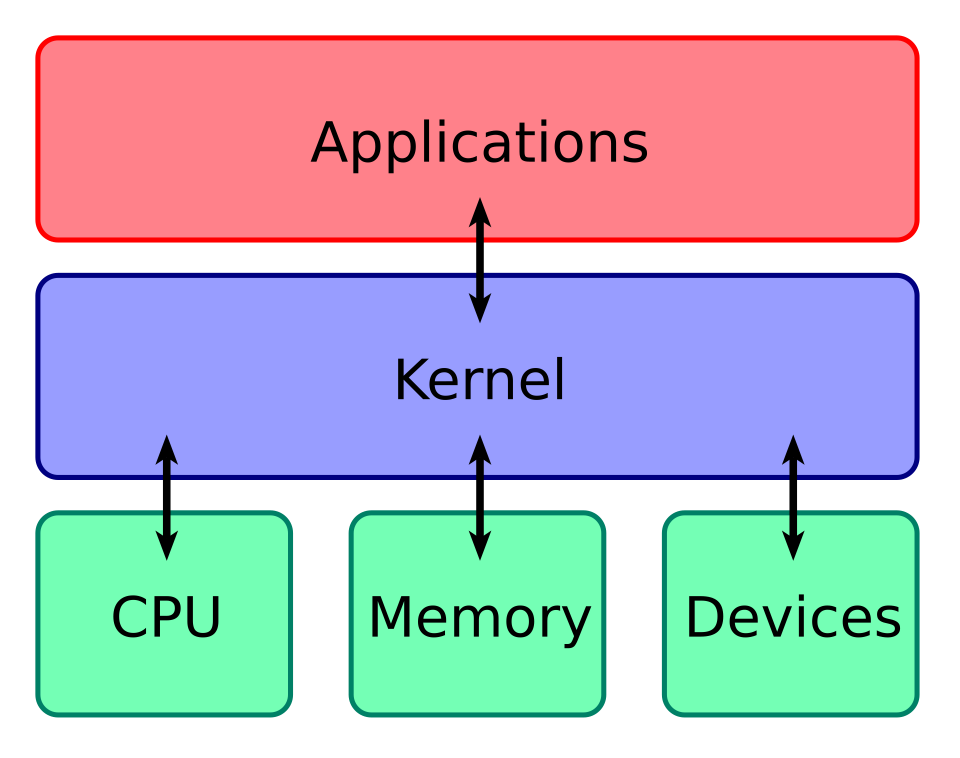
(Source: Wikipedia )
Unlike other kernels, like the one used by Windows, Linux is open-source, which means anyone is free to view, modify and re-distribute its source code, provided they abide by the terms of its license. You almost certainly interact with the Linux kernel on a daily basis, as it runs a lot of the world’s web infrastructure, and is used as the kernel for countless devices from supercomputers to car entertainment systems. It is used in mission critical systems by space agencies, defence departments, stock exchanges, and many other organisations. It’s everywhere.
When people say “Linux” they are rarely referring to the kernel itself, but rather the family of operating systems that use the Linux kernel. These operating systems are referred to as Linux distributions. There are a lot of Linux distributions , used by various people and organisations for different purposes.
How is it free?
We tend not to trust things that come for free, especially with software. Maybe that’s modern cynicism, maybe it’s Microsoft induced hysteria , but it’s just the way we are. I want to try and dispel this notion by asking you to quickly visit the Linux Foundation’s membership page . Linux is, simply put, among the most vital tools on the planet. As a result, 1300+ of the world’s largest organisations (including Microsoft) are willing to fund development to keep it alive.
These organisations support Linux and open source development because it represents a good return on investment over developing their own systems, but Linux is not only useful for commercial purposes, Linux is used by many everyday people, and there is an army of talented enthusiasts willing to make similarly useful contributions to help its development.
You might here Linux, and other open-source projects, referred to as FOSS (Free and Open Source Software), but there is an important distinction to be made, although Linux is free to use as a result of its distribution model, the “Free” in FOSS doesn’t mean free in the sense that you don’t pay for it, it refers to the freedom the software gives you:
“Free software means that the users have the freedom to run, edit, contribute to, and share the software. Thus, free software is a matter of liberty, not price.”
The Free Software Foundation (FSF) *
That is a major reason why I love Linux - it gives me the liberty to do with my computer, that I own and bought with my money, what I want. For better or worse, that is a dying phenomenon in today’s consumer world. See: Apple, John Deere, etc.
* The FSF is a non-profit organisation founded in the 1980s to defend the rights of software users. It publishes the licenses used by Linux and many other open source projects.